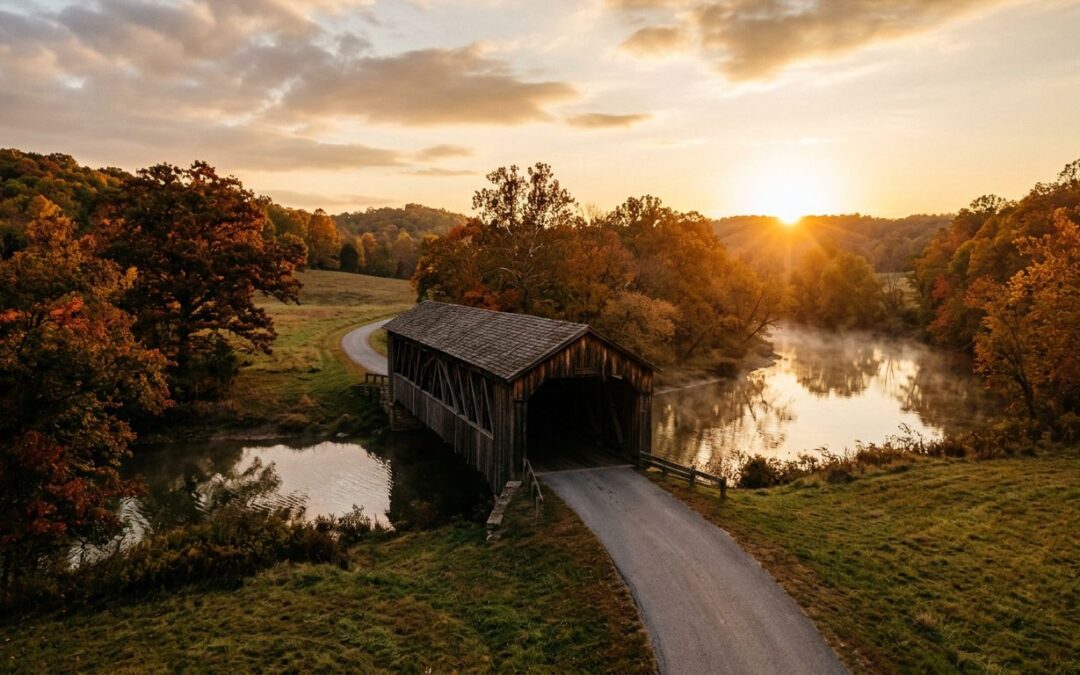
Some places in Kentucky ask for a long stay. Covered bridges do not. They ask for a tank of gas, a little attention, and a willingness to leave the interstate behind.
For those of us in Northern Kentucky, that is a fair trade. The covered bridges northern kentucky offers are close enough for a day trip, but old enough to remind us that roads once had a different rhythm.
We do not go looking for these bridges because they are flashy. We go because they are honest, useful, and rare. Let's look at the ones worth putting on the map for your next scenic road trip.
Key Takeaways
- Covered bridges are rare, functional pieces of Kentucky history that offer an authentic alternative to modern, fast-paced travel.
- A successful bridge tour requires patience and a slower pace; rather than rushing between stops, focus on the surrounding landscape and the quiet nature of the rural roads.
- While Northern Kentucky offers easy access to historic sites like the Dover Covered Bridge, a longer, more rewarding day trip can be built by exploring the concentrated bridge clusters in Fleming and surrounding counties.
- These structures are historical landmarks, not just photography props; visitors should practice respectful behavior, avoid blocking entrances, and be mindful of traffic safety near narrow spans.
Why these bridges still matter
A covered bridge is not mere decoration. It is a working piece of Kentucky history, and it still knows how to hold a road. That is the first thing to understand, because if we treat these surviving bridges like props, we miss the point.
Kentucky does not have an endless supply of them. The list of Kentucky covered bridges is short, and that scarcity matters. Many of these sites are even listed on the National Register of Historic Places, which highlights their status as vital cultural treasures. These structures have survived weather, age, and the simple pressure of time. They are not common, and they are certainly not convenient. That is part of their beauty.
Rare things ask for careful attention, and Kentucky's covered bridges are rare.
When we pull up to one of these historical landmarks, we are not just looking at wood and nails. We are looking at a road built for another Kentucky, one where the pace was slower and the distance between towns felt larger. The bridge frames the creek, the creek frames the bridge, and for a moment the whole scene becomes plain truth.
That is why these stops still work. They give us history without a museum glass case. They give us travel without the noise. They give us a reason to leave the city for a while and remember that our commonwealth still holds quiet places worth seeing.
The bridges we would put first
If we are choosing the best covered bridges for a Northern Kentucky day trip, we should start with the ones that are reachable, memorable, and still tied to the land around them. A good bridge route is not about checking boxes. It is about letting one stop lead cleanly into the next.
| Bridge | Where to find it | Why we stop |
|---|---|---|
| Dover Covered Bridge | Mason County | One of the oldest, open to walking and driving |
| Walcott Covered Bridge | Bracken County | Classic look, easy to add to a loop |
| Valley Pike Covered Bridge | Fleming County | Quiet setting for a slower road trip |
| Johnson Creek Covered Bridge | Robertson County | Historic character and a graceful span |
| Cabin Creek Covered Bridge | Lewis County | One of Kentucky's longest surviving bridges |
| Goddard White Covered Bridge | Fleming County | Exceptional town lattice truss design |
| Grange City Covered Bridge | Fleming County | Historic charm near Flemingsburg |
| Ringo's Mill Covered Bridge | Fleming County | Iconic local landmark |
Dover Covered Bridge is the one we would send most visitors to first. Located in Mason County, it crosses Lees Creek on a single span of about 110 feet, and it still feels like a bridge with a pulse. As one of the most photographed structures in the region, the Dover Covered Bridge is close enough to make sense for a simple day trip from the Cincinnati area. That is a hard combination to beat.
Walcott Covered Bridge belongs on the route because it rewards the traveler who keeps going. Situated in Bracken County, the Walcott Covered Bridge gives us that classic aesthetic without demanding a whole weekend. If we are building a route instead of chasing one stop, the Walcott Covered Bridge belongs in the middle of it.
Valley Pike Covered Bridge is quieter, and that quiet is the point. It sits in Fleming County, across a small creek, and it feels less like a destination built for crowds and more like a place the road simply decided to keep. Nearby, Flemingsburg serves as an ideal hub for exploring the local Fleming County sites. This area is home to the Goddard White Covered Bridge, which showcases an intricate town lattice truss, as well as the Grange City Covered Bridge and Ringo's Mill Covered Bridge, both of which highlight the region's historic wooden trusses.
Johnson Creek Covered Bridge and Cabin Creek Covered Bridge are for the traveler who wants a longer pull and is willing to earn it. The Johnson Creek Covered Bridge is known for its strong truss design and its length, while the Cabin Creek Covered Bridge in Lewis County stretches even farther and stands among the longest surviving covered bridges in the state. The Johnson Creek Covered Bridge and Cabin Creek Covered Bridge are not casual roadside glances. They are destinations for people who want the old road still speaking back.
For a longer loop, Moon Travel Guides' Kentucky covered bridges road trip lays out the kind of route that rewards patience. That is the right spirit here. We are not hurrying through. We are collecting real places. Some structures utilize a simple King post truss for stability, while others feature complex wooden trusses, but all of them serve as a reminder of the craftsmanship that defined Kentucky travel long ago.
How to turn the bridge hunt into a proper day trip
A covered bridge hunt works best when we stop pretending it is a race. If we leave Northern Kentucky and try to cram everything into one rushed sweep, we will miss the whole point of this scenic road trip. These structures ask for steady driving, a few clean stops, and a little room to breathe between them.
If we want a simple start, we can begin in Newport and move out from there. For travelers who want to pair bridge hunting with riverfront time, things to do in Newport KY provides a strong foundation for a tourism itinerary before we head east. This is a wise way to begin, because Newport offers plenty of food, views, and a clean launch point before the road gets quieter.
Then we should choose a lane and stay with it. Dover works well as the first target because it is the most approachable for a shorter outing. If we have more time, we can keep moving toward Maysville and Fleming County, where the bridge stops begin to feel like pieces of the same story. That is how a Kentucky day trip ought to work, with one stop leading to the next without any unnecessary strain.
We should also keep our expectations straight. These are not grand tourist compounds. They are working bridges, narrow bridges, and old bridges. They are the kind of places where slowing down is not optional, it is the right response. If we want beauty without noise, this is the path.
What we should know before we go
The best covered-bridge trips are simple, but simple does not mean careless. A little planning keeps the day peaceful and keeps the structures safe.
- Use the bridge names in GPS. Rural directions can get vague fast, and the bridge names are the clearest way to reach your destination.
- Go early or late. Morning and late afternoon light give us better pictures and calmer roads.
- Do not block the entrance. These bridges are narrow, and traffic still matters.
- Watch the road surface. Some approaches are tight, and it pays to slow down before the bridge, not on it.
- Bring water and snacks. A bridge route is better when we are not forced to rush back to town too soon.
We should also dress for the road, not for a brochure. Comfortable shoes help if we walk the span or step out for photos. A charged phone helps, too, because the best bridge picture is the one we actually get, not the one we meant to take.
There is one more plain truth here. Authentic covered bridges look best when we respect them. They are not backdrops for careless parking or loud behavior. They are pieces of Kentucky history that survived long enough for us to stand in front of them. That deserves a better response than haste.
Frequently Asked Questions
Can I drive my car through these covered bridges?
Most of the bridges listed, including the Dover Covered Bridge, are open to both walking and vehicular traffic. However, you should always approach slowly and carefully, as these historic structures are narrow and designed for a much different era of travel.
Is one day enough to see all the covered bridges in Kentucky?
Because these bridges are spread across different counties, it is difficult to see every single one in a single day without constant rushing. It is better to focus on a regional loop—such as starting with Dover and heading toward the Fleming County cluster—to keep the trip relaxed and enjoyable.
What is the best time of year to visit these bridges?
These bridges are beautiful throughout the changing seasons, but early spring and autumn offer the most pleasant weather for walking around the sites. Visiting during the early morning or late afternoon also provides the best light for photography and typically avoids the busiest road traffic.
Do I need special equipment for a covered bridge road trip?
No special equipment is required, though bringing a reliable GPS is helpful as rural road signage can sometimes be minimal. It is also wise to pack water and snacks, as many of these historic bridges are located in quiet, rural areas away from convenience stores or restaurants.
The right kind of Kentucky detour
The true beauty of these structures is not simply their age, but their endurance. They have stood firm through the passing of generations and the historical turbulence of the Civil War, remaining constant fixtures in our landscape. They still sit over the water and mark the road, offering a brief moment to realize that the Bluegrass region is far more expansive than our daily rush. Thanks to the diligent efforts of every restoration project aimed at preserving these landmarks, they continue to serve as vital links to our past.
If you are leaving Northern Kentucky for a day, this is a worthy direction to take. Dover provides an easy start to your journey, while the sites at Walcott and Valley Pike deepen the experience. Traveling further to Johnson Creek and Cabin Creek will reward any explorer who is eager to keep going.
You do not need a grand plan to enjoy these pieces of history. You simply need a little time, enough fuel, and the willingness to choose the slower road. That is enough to turn a drive into a lasting memory.